Francophone Mobility Program (C16) in Canada: Questions and Answers for 2026
By Pooneh Ghasvareh, RCIC · Verify RCIC registration
How Can French-Speaking Foreign Workers Obtain an LMIA-Exempt Canadian Work Permit?
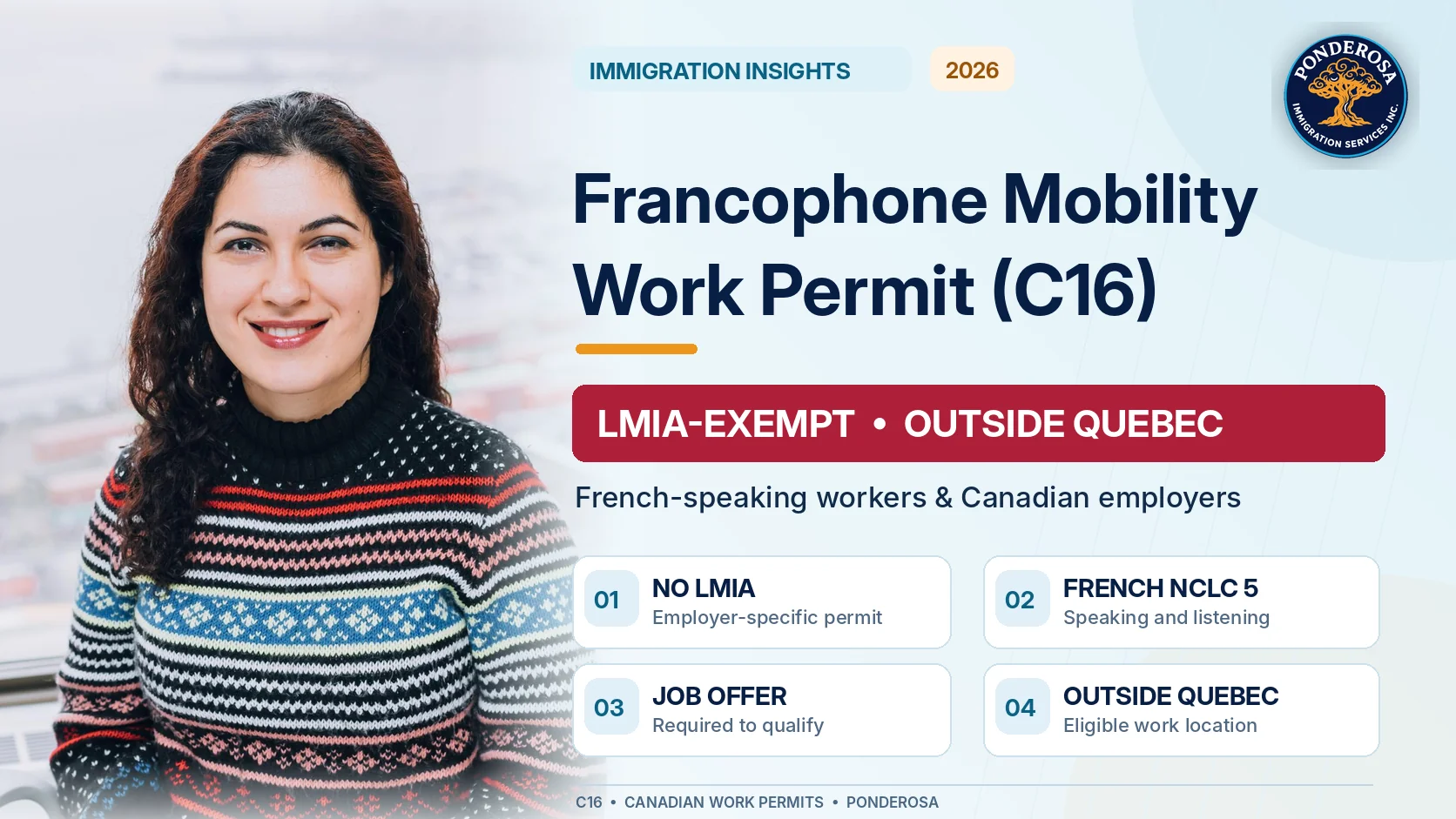
Canada's Francophone Mobility Program offers an opportunity for French-speaking foreign nationals to work in Canada without requiring their employers to obtain a Labour Market Impact Assessment (LMIA). The program supports the growth of Francophone communities outside Quebec while making it easier for Canadian employers to recruit French-speaking workers.
Below, we answer frequently asked questions about eligibility, language requirements, job offers, employer obligations, work permit applications, and pathways to permanent residence.
1. What is the Francophone Mobility Program?
The Francophone Mobility Program, also known as Mobilité Francophone, is a Canadian work permit category under the International Mobility Program (IMP). It allows eligible French-speaking foreign nationals to obtain an employer-specific work permit for employment outside Quebec without requiring a Labour Market Impact Assessment (LMIA). The program is intended to promote the use of French and support Francophone minority communities across Canada.
2. What is the C16 LMIA exemption code?
C16 is the administrative exemption code assigned to the Francophone Mobility Program. For applications submitted on or after June 15, 2023, this exemption falls under subparagraph 205(c)(ii) of the Immigration and Refugee Protection Regulations (IRPR). The code allows qualifying employers to hire eligible French-speaking foreign workers without obtaining an LMIA. However, the employer must still submit an offer of employment to IRCC and comply with applicable employer obligations.
3. Who is eligible for the Francophone Mobility Program?
To qualify, a foreign national must have a genuine job offer for an eligible position outside Quebec, demonstrate French-speaking and listening abilities equivalent to at least NCLC level 5, and meet the general requirements for obtaining a Canadian work permit. The applicant must also be qualified to perform the duties of the offered occupation and satisfy applicable immigration admissibility requirements.
4. What level of French is required to qualify?
Applicants must demonstrate an intermediate level of French equivalent to NCLC 5 or higher in both speaking and listening. Unlike many permanent residence programs, the Francophone Mobility Program does not require applicants to demonstrate French reading or writing proficiency. The NCLC 5 requirement applies to applications submitted on or after June 15, 2023, replacing the more restrictive language requirements that applied to earlier applications.
5. Do I need to take TEF or TCF to prove my French language ability?
Not necessarily. Although results from the Test d'évaluation de français (TEF) or Test de connaissance du français (TCF) can be used to demonstrate the required language ability, IRCC also accepts other forms of evidence. These may include an official transcript, a letter confirming completion of a college or university program taught in French, or other documentation demonstrating education in French. Immigration officers have discretion to determine whether the evidence is sufficient and may request additional language testing or an oral assessment if necessary.
6. Can I qualify if French is not my first language?
Yes. Applicants are not required to be native French speakers or citizens of a French-speaking country. What matters is whether they can demonstrate the required French-speaking and listening abilities. A foreign national whose first language is English, Spanish, Arabic, or another language may qualify if they satisfy the minimum NCLC 5 requirement and all other eligibility conditions.
7. Does my job need to be performed in French?
No. IRCC explicitly confirms that the language of work does not need to be French. This means that an eligible applicant may work in an English-speaking or bilingual workplace and still qualify under the Francophone Mobility Program. The key language requirement relates to the applicant's ability to communicate in French, not the language used by the employer or during daily work activities.
8. What types of jobs are eligible under the Francophone Mobility Program?
The program accepts job offers across all six Training, Education, Experience and Responsibilities (TEER) categories under Canada's National Occupational Classification (NOC) system. This includes management, professional, technical, skilled trades, intermediate, and other occupations classified under TEER 0 through TEER 5. However, primary agriculture occupations classified under TEER 4 and 5 are excluded. Applicants must still demonstrate that they meet the employment requirements associated with the offered position.
9. Do I need a job offer to apply for a C16 work permit?
Yes. The Francophone Mobility Program is an employer-driven work permit category, so applicants must have a genuine offer of employment from an employer eligible to hire them under the program. The employer must submit the employment information to IRCC before the foreign worker applies for the work permit. French proficiency alone does not make someone eligible to receive a C16 work permit without a qualifying job offer.
10. Can I apply for a Francophone Mobility work permit if my job is in Quebec?
No. The program is specifically intended for foreign nationals who will live and work in a Canadian province or territory outside Quebec. Jobs physically located in Quebec are not eligible. IRCC also specifies that telework or remote work for an employer located in Quebec is not eligible under this exemption. Applicants planning to work in Quebec should consider other applicable immigration and work permit options.
11. Can a Canadian employer hire me without an LMIA under this program?
Yes. One of the main benefits of the Francophone Mobility Program is that employers do not need an LMIA to hire qualifying French-speaking foreign nationals. Under the regular LMIA process, employers generally have to demonstrate that hiring a foreign worker will not negatively affect Canada's labour market. The C16 exemption removes that assessment requirement, although the employer must still submit the required employment information, pay the applicable employer compliance fee unless exempt, and respect Canadian employment and immigration laws.
12. What must an employer do before I apply for a C16 work permit?
Before the foreign worker submits an application, the Canadian employer generally must register or sign in to the IRCC Employer Portal, submit an offer of employment using LMIA exemption code C16, and pay the $230 employer compliance fee unless an exemption applies. Once the offer is submitted, the employer receives an offer of employment number, which must be provided to the applicant. This number is required to connect the employer's submission with the foreign worker's work permit application.
Need help with a Francophone Mobility (C16) work permit or an employer’s LMIA-exempt offer? Book a 30-minute immigration consultation to discuss your circumstances.
13. How much does it cost to apply for a Francophone Mobility work permit?
The standard work permit processing fee is CAD $155. In addition, employers generally pay a CAD $230 employer compliance fee when submitting the LMIA-exempt offer of employment. Applicants may also have to pay biometrics fees, depending on their circumstances and whether their existing biometrics remain valid. Other potential costs include document translation, medical examinations where required, and professional representation fees if an immigration representative is retained.
14. How do I apply for a Francophone Mobility work permit?
The application process begins when the employer submits the qualifying offer of employment through the IRCC Employer Portal. After receiving the offer of employment number, the foreign worker can prepare the work permit application using the applicable IRCC application process. Supporting documents typically include identity documents, evidence of French language proficiency, information about the employment offer, and documentation showing that the applicant is qualified for the position. The applicant must also satisfy the general eligibility and admissibility requirements for a Canadian work permit.
15. Can I apply for a C16 work permit from inside Canada?
Possibly. Foreign nationals who are already in Canada may apply for a Francophone Mobility work permit from within Canada if they meet both the requirements of the C16 exemption and the rules governing who may submit a work permit application from inside the country. Simply holding visitor status does not automatically make someone eligible to apply from within Canada. Applicants should assess their current immigration status and eligibility under the applicable in-Canada application rules before submitting an application.
16. How long does it take to process a Francophone Mobility work permit?
Processing times vary depending on where the application is submitted, the applicant's circumstances, the completeness of the application, and IRCC's processing capacity. Because the program is LMIA-exempt, employers can avoid the separate LMIA assessment stage. However, this does not guarantee that the work permit application itself will be approved or processed within a particular period. Applicants should consult IRCC's current processing-time estimates rather than relying on fixed timelines.
17. Is the Francophone Mobility work permit an open work permit?
No. The Francophone Mobility Program generally results in an employer-specific work permit, commonly referred to as a closed work permit. The permit identifies the authorized employer and may impose conditions relating to the occupation or work location. A foreign national who wishes to change employers or work outside the conditions of the existing permit will generally need new authorization before beginning the new employment.
18. How long is a C16 work permit valid?
The validity period generally depends on the duration of the employment offer and the applicant's travel document validity, along with other applicable immigration requirements. IRCC may issue the permit for the period of employment indicated in the offer, subject to relevant restrictions. There is no universal two-year validity period that applies to every C16 application. The authorized duration is determined when the work permit is issued.
19. Can my spouse or common-law partner obtain an open work permit?
Possibly. The spouse or common-law partner of a Francophone Mobility work permit holder may be eligible for an open work permit under the rules applicable to family members of foreign workers. Eligibility depends on factors such as the principal worker's occupation, work permit validity, and the family-member eligibility criteria in effect when the application is submitted. Holding a C16 work permit does not automatically guarantee that accompanying family members will receive open work permits.
20. Can my children accompany me to Canada?
Yes, dependent children may be able to accompany a Francophone Mobility work permit holder, provided they satisfy the applicable temporary resident requirements. Depending on their age, circumstances, and intended activities in Canada, they may need visitor documentation or study permits. Any entitlement to study without a separate study permit must be assessed under the rules applicable to the child's circumstances.
21. Can I extend my Francophone Mobility work permit?
Yes, eligible workers may apply to extend their employer-specific work permits if they continue to satisfy the program requirements and the employer completes any necessary new offer of employment submission. For applications originally assessed under the rules introduced on June 15, 2023, IRCC generally does not require new evidence of French language proficiency at renewal unless the processing officer has concerns. However, the applicant must continue to meet all other applicable requirements, and an extension is not automatic.
22. Can the Francophone Mobility Program help me become a permanent resident?
The Francophone Mobility Program is a temporary work permit category rather than a permanent residence pathway. However, qualifying Canadian work experience gained while holding a C16 work permit may help an applicant meet the requirements of certain economic immigration programs. Depending on the applicant's qualifications and circumstances, potential options may include Express Entry, provincial nominee programs, or the Francophone Community Immigration Pilot. Each program has its own eligibility requirements, and approval of a C16 work permit does not guarantee permanent residence.
23. Can I qualify for Express Entry through the Francophone Mobility Program?
Possibly. Canadian work experience gained under a valid C16 work permit may count toward Express Entry eligibility if it meets the requirements of the applicable immigration program. For example, qualifying work experience in a TEER 0, 1, 2, or 3 occupation may be relevant to the Canadian Experience Class. However, work performed in TEER 4 or 5 occupations generally does not qualify as skilled work experience for that program. Applicants must separately meet the language, employment, and other requirements of the Express Entry program under which they intend to apply.
24. Does knowing French improve my chances of obtaining Canadian permanent residence?
It can. French proficiency may provide additional advantages under certain Canadian permanent residence programs, including Express Entry's French-language selection category and additional Comprehensive Ranking System points. However, the language requirements for permanent residence are not necessarily the same as those for a C16 work permit. For example, Express Entry's French-language category requires at least NCLC 7 in all four language abilities. Meeting NCLC 5 in speaking and listening for a C16 work permit does not automatically establish eligibility for French-language-based permanent residence selection.
25. What are the most common reasons a C16 work permit application may be refused?
An application may be refused if the applicant cannot adequately demonstrate the required French proficiency, does not have an eligible job offer outside Quebec, lacks the qualifications required for the occupation, or fails to meet general work permit eligibility or admissibility requirements. IRCC may also examine whether the employment offer is genuine, whether the employer can reasonably support the position, and whether the information submitted by the employer and applicant is consistent. Providing complete, accurate, and well-organized supporting documentation can help address these concerns.
Conclusion
The Francophone Mobility Program offers an important opportunity for French-speaking foreign nationals and Canadian employers outside Quebec. By eliminating the LMIA requirement and accepting eligible occupations across TEER categories 0 to 5, the program provides greater flexibility than many traditional employer-sponsored work permit pathways.
However, applicants must still demonstrate the required French language proficiency, secure a genuine qualifying job offer, and satisfy all applicable work permit requirements. Those interested in permanent residence should also consider how their occupation, Canadian work experience, and language qualifications align with the requirements of potential immigration pathways.
Need help with a Francophone Mobility (C16) work permit or an employer’s LMIA-exempt offer? Book a 30-minute immigration consultation to discuss your circumstances.
Disclaimer: This article provides general immigration information based on IRCC guidance available as of October 27, 2026. It is not a substitute for an individualized assessment of eligibility.
Official references
- IRCC — Francophone Mobility: Operational Instructions (C16)
- IRCC — Francophone Mobility Work Permit: Eligibility
- IRCC — How to Apply
- IRCC — After You Apply
Related immigration guidance
Maintained Status in Canada: Your Questions Answered · Ponderosa Immigration Services · Ask about your C16 work permit