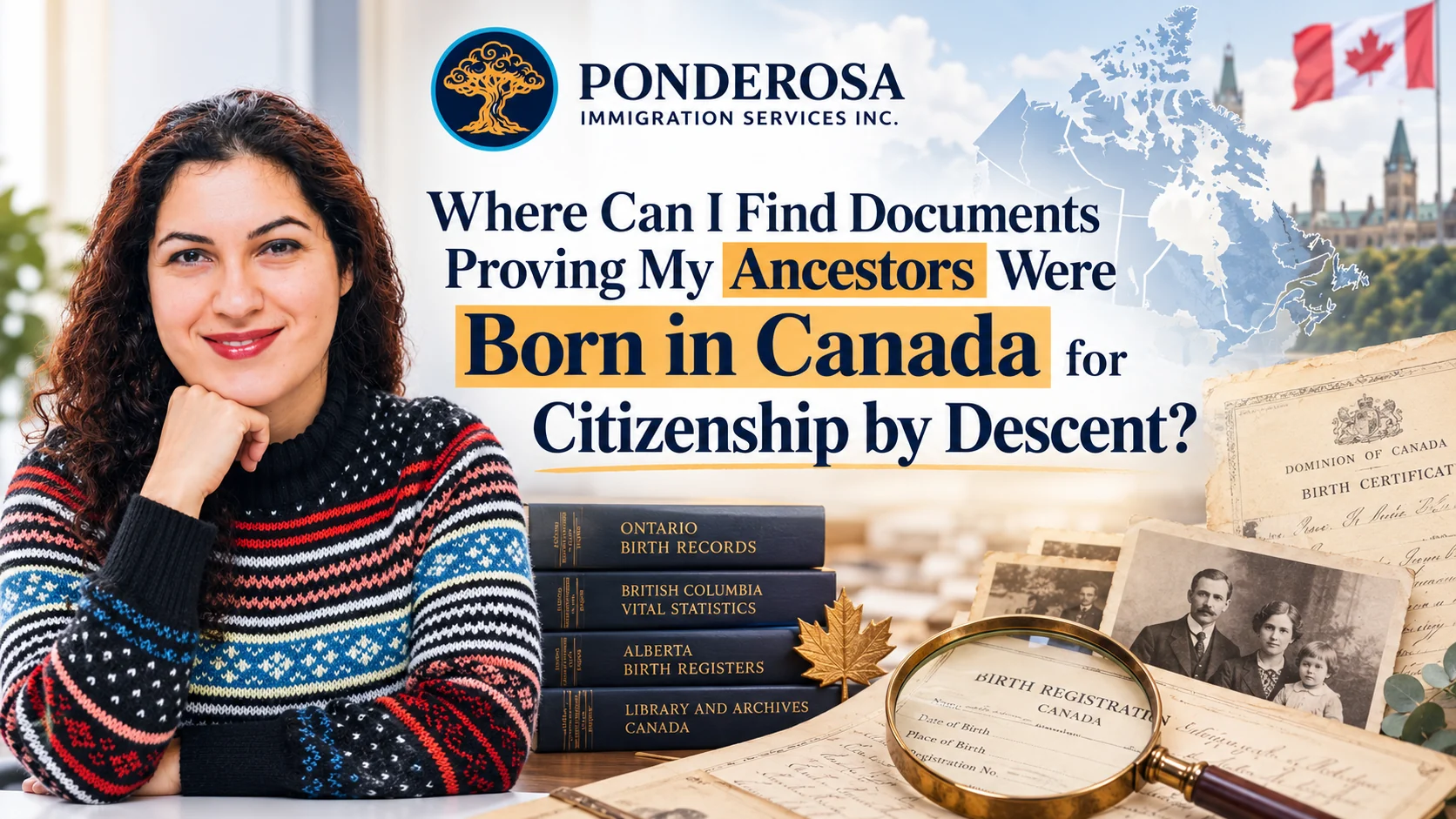
Where Can I Find Documents Proving My Ancestors Were Born in Canada for Citizenship by Descent?
By Pooneh Ghasvareh, RCIC · Verify RCIC registration
In Canada, birth certificates are issued by provincial or territorial governments, not the federal government. However, the date when a government began registering births is not necessarily the date when birth certificates first became available.
For family history research, particularly when establishing a documentary chain of descent, three distinctions are important:
Civil birth registration: The original government records documenting birth.
Birth certificate: An official document issued using information from the birth registration.
Historical birth record: An archived registration, parish record, baptismal record, or other historical document that may establish birth and parentage.
Library and Archives Canada confirms that most birth registrations and certificates are maintained by provincial and territorial authorities rather than the federal government. Birth, marriage, death and divorce records – Canada.ca
1. Canadian provinces: Birth registration dates and official records
The following consolidated table provides the earliest civil birth registration dates, official sources, and information about searching historical records.
| Province | Registration began | Official source (click to open) | Historical availability / exception |
|---|---|---|---|
| British Columbia | 1872 | BC Archives — Genealogy Search | Historical index includes births from 1854–1904; some records predate general civil registration. Historical birth records are generally released after 120 years. |
| Alberta | 1870 (earliest archived records) | Provincial Archives — Birth Indexes | Archived registrations include 1870–1906, preceding Alberta’s establishment as a province in 1905. Copies are ordered through the archives. |
| Saskatchewan | Early 1900s; earlier territorial records | eHealth Saskatchewan — Genealogy | Births registered more than 100 years ago may be searched. Exact starting year of the surviving provincial series was not conclusively verified. |
| Manitoba | 1882 | Manitoba — Genealogy Search | Historical birth records older than 100 years are searchable. Copies can be requested from Vital Statistics. |
| Ontario | 1869 | Archives of Ontario — Birth, Marriage and Death | Archived registrations extend to roughly 1919–1920 according to published guidance. Earlier church and township records may be useful. |
| Quebec | Earlier parish/civil registers; centralized register from 1994 | Quebec — Directeur de l’état civil | Historical parish and civil registers go back to the 1600s. The linked agency issues modern official certificates; BAnQ holds historical registers. |
| New Brunswick | 1888 (general compulsory registration) | Provincial Archives of New Brunswick | Historic records generally become public after 95 years. Delayed registrations may document births from 1810 onward. Archive site access may vary. |
| Nova Scotia | 1864–1877; resumed October 1, 1908 | Nova Scotia Archives — Birth Registrations | Free historical record images are available. There is a major registration gap between 1877 and 1908; delayed registrations partly bridge it. |
| Prince Edward Island | 1906 | PEI Public Archives — Genealogy | Baptismal records (1777–1923) are useful for earlier births. Historical civil birth records generally have a 120-year restriction; archives do not issue certificates. |
| Newfoundland and Labrador | 1892 | NL Government — Birth Certificates | Vital Statistics holds records from 1892 onward. For earlier records, consult church materials and The Rooms provincial archives. |
3. What if a person was born before civil registration began?
A birth before the dates in the first table does not necessarily mean no official or historical evidence exists. For example:
Quebec: Surviving parish register dates back to 1621. These are especially valuable for tracing families over multiple generations.
British Columbia: Although general civil registration began in 1872, the provincial archive's historical birth collection includes some earlier records dating to 1854.
New Brunswick: The provincial archives hold delayed birth registrations extending back to 1810.
Nova Scotia: Some individuals born before 1908 registered their births later, providing supporting documents such as church entries, family Bible extracts, and census records.
Prince Edward Island: The provincial archive provides baptismal records from 1777–1923, even though routine civil registration only began in 1906
4. Which birth document is best for genealogy or Canadian citizenship by descent?
| Document | Information provided | Usefulness |
|---|---|---|
| Short-form birth certificate | Name, date and place of birth | Limited if parents are not identified |
| Long-form birth certificate | Birth details and parents' names | Strong evidence of parentage |
| Certified copy of original registration | Original registered information, often including parental details | Particularly valuable for establishing a documented family connection |
| Historical baptismal or parish record | Birth or baptism details, parents and sometimes additional family information | Important for births predating government registration |
| Delayed birth registration | Birth information registered after the event | Useful when contemporary civil registration is unavailable |
Important distinction: A historical registration located through a provincial archive may be suitable genealogical evidence, but an uncertified online image should not automatically be treated as equivalent to an official birth certificate. For citizenship applications, the document must meet IRCC's applicable evidence requirements.
5. Recommended Approach to Finding Your Ancestors’ Birth Records
Start with the province and approximate birth year. Search the official provincial archive for the registration and, if available, obtain a certified copy identifying the parents. If the person was born before government registration began, search church, parish, baptismal and delayed-registration records.
For very old Canadian family lines, particularly those extending into the 1700s or 1800s, historical parish registers can be more valuable than modern certificate databases.
6. Do I need the help of a genealogist to find my ancestorial documents?
Whether you need to hire a genealogist to trace your family history depends on several factors, including the complexity of your case, how much you already know about your Canadian ancestors, and how much time and effort you are willing to invest in the research.
For example, knowing the city or township where your ancestors lived or first settled in Canada, along with the approximate dates they were there, can make your search much easier.
It also depends on whether you prefer to conduct the research yourself or take a more hands-off approach by hiring a professional who knows where and how to find historical records.
Sometimes, when the research becomes difficult or frustrating, seeking professional help may be the best option.
Official citizenship certificate document requirements
IRCC: Official documents proving each generation of Canadian ancestry
Related citizenship-by-descent guidance
Canadian Citizenship by Descent · Documents for Canadian Citizenship by Descent · How to Prove Your Ancestor Was Canadian