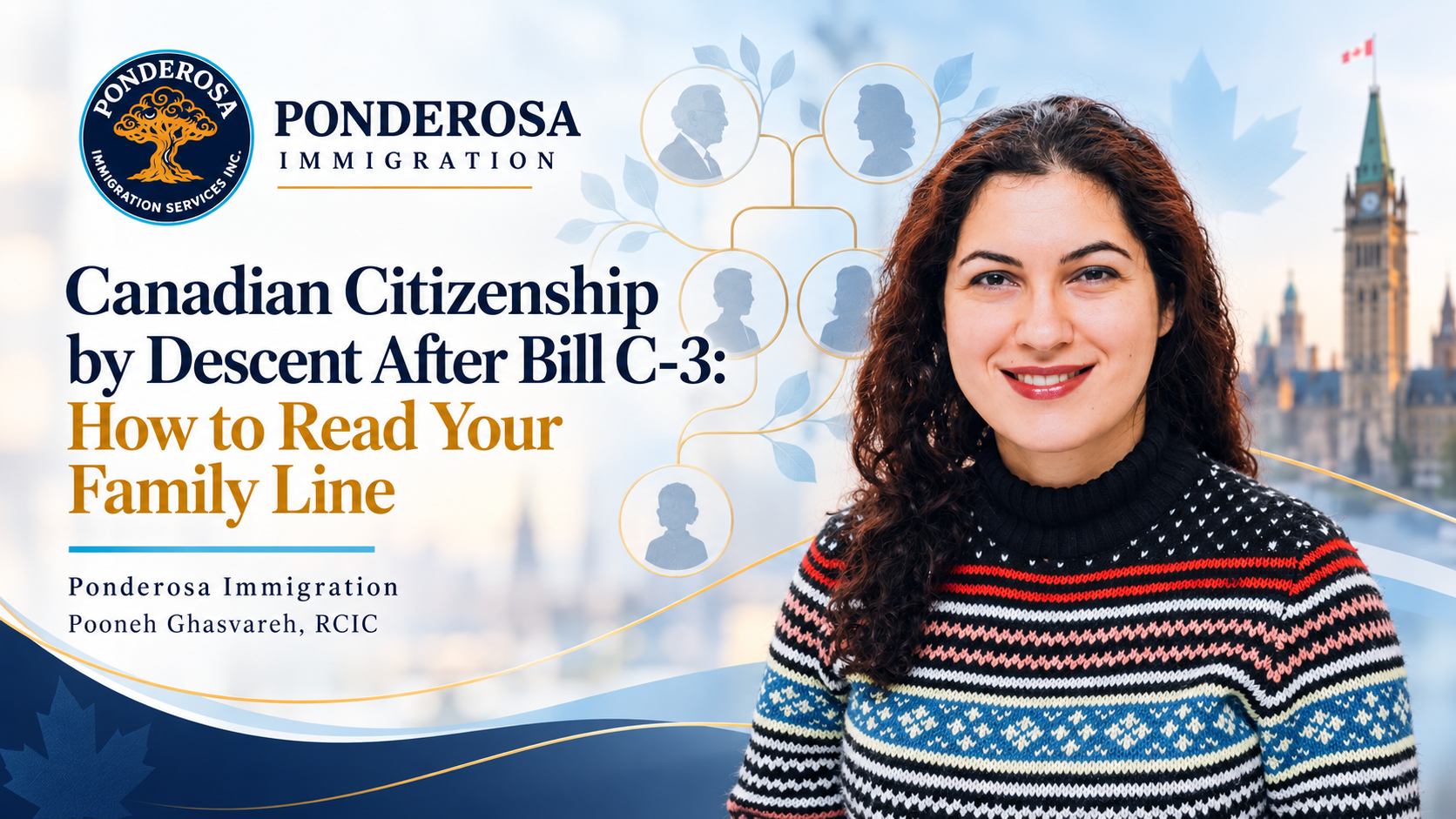
Canadian Citizenship by Descent After Bill C-3: How to Read Your Family Line

If you have a Canadian parent or grandparent, you may have wondered:
Could I already be a Canadian citizen?
For some people, the answer changed on December 15, 2025, when a new law, Bill C-3, came into effect.
The law changed who can be Canadian by descent. It matters most for families where more than one generation was born outside Canada.
The most important thing to understand is this:
You may not need to apply to become Canadian. You may already be Canadian and simply need proof of your citizenship.
The answer depends on your family history.
First, what is citizenship by descent?
Citizenship by descent means you may be Canadian because one of your parents was Canadian when you were born.
For example:
- Your mother was born in Canada.
- You were born in the United States.
- You may have received Canadian citizenship through your mother.
That is the basic idea.
Things become more complicated when your Canadian parent was also born outside Canada.
For many years, Canada limited how far citizenship could be passed down to children born abroad.
Not sure how Bill C-3 affects your family’s Canadian citizenship?
What was the old rule?
In 2009, Canada added a rule often called the first-generation limit.
In simple terms, citizenship could usually be passed to a child born abroad only once.
If a Canadian parent was born in Canada, or had moved to Canada and became a citizen by applying, they could generally pass citizenship to a child born outside Canada.
But if the Canadian parent was themselves born outside Canada and was a citizen only because their own parent was Canadian, they generally could not automatically pass citizenship to another child born abroad.
So citizenship could effectively stop after the first generation born outside Canada.
What did Bill C-3 change?
Bill C-3 changed that old first-generation rule.
For many people born outside Canada before December 15, 2025, the old limit no longer blocks citizenship in the same way.
Immigration, Refugees and Citizenship Canada — IRCC, the government department that handles citizenship — says that many people who were previously excluded may now already be Canadian.
That can include some grandchildren and great-grandchildren of Canadians who were left out under the old rule.
So for many families, the better question is now:
“Am I already Canadian?”
instead of:
“Can I apply to become Canadian?”
A simple family example
Imagine this family:
Grandmother: born in Canada Mother: born in the United States You: born in the United States
Your mother is the first person in the family born outside Canada.
You are the second.
Under the old rule, your mother would generally have been Canadian through her Canadian-born mother.
But you may have been excluded because both you and your mother were born outside Canada.
If you were born before December 15, 2025, Bill C-3 may mean you are now already a Canadian citizen.
If that is the case, your next step may be to apply for a citizenship certificate — the official document that proves you are Canadian.
You would not be applying to become Canadian. You would be asking Canada to confirm citizenship you already have.
What if the Canadian parent became Canadian later?
Here is a different example.
Suppose a mother was born in the United States to non-Canadian parents.
She later moved to Canada and became a Canadian citizen.
After becoming Canadian, she had a child in the United States.
That child may already have been Canadian under the older rules because the mother had become a Canadian citizen before the child was born.
In that situation, Bill C-3 may not be what makes the child Canadian.
The child may have been Canadian all along.
This is why it matters to know how and when the Canadian parent became a citizen.
What about children born on or after December 15, 2025?
There is a different rule for children born abroad on or after December 15, 2025.
If the Canadian parent was also born or adopted outside Canada, that parent generally needs to show they spent at least:
1,095 days — three years added up — in Canada before the child was born.
Canada calls this a substantial connection to Canada.
In simple terms, the parent must have spent enough time living in Canada before passing citizenship to the next generation born abroad.
So Bill C-3 did not simply remove every limit forever.
Instead:
- many people born before December 15, 2025 may now already be Canadian;
- children born abroad after that date may qualify if their Canadian parent meets the 1,095-day rule.
What if the child was adopted?
Adoption has different rules.
An adopted child does not automatically become Canadian in exactly the same way as a child born abroad to a Canadian parent.
For some children adopted by a Canadian parent born abroad, before December 15, 2025, Bill C-3 may make them eligible to apply for citizenship through a special process.
For an adoption on or after December 15, 2025, where the Canadian parent was also born or adopted outside Canada, that parent generally needs to have spent at least 1,095 days in Canada before the adoption.
So if adoption is part of your family history, it needs to be looked at separately.
Why can older family histories be more complicated?
Some cases go back much further than a parent or grandparent.
For example, your family history may involve:
- someone born before the Canadian Citizenship Act came into effect in 1947;
- someone who lost Canadian citizenship under an old rule, such as a woman who married a foreign national;
- someone whose citizenship was later restored;
- an adoption; or
- a deceased ancestor whose citizenship still affects the family line.
Older Canadian laws sometimes treated people differently based on factors that may seem unusual today.
Citizenship could depend on whether the Canadian parent was the mother or the father, whether the parents were married, or whether someone completed certain steps to retain their citizenship.
Changes to the law in 2009 and 2015 addressed some of these issues, and Bill C-3 helped include people who had still been left out.
You do not need to understand all these older laws yourself. A useful starting point is simply to establish the facts of your family history.
What information should you gather?
Start with what you already know about your family history.
Try to collect:
- Your date and place of birth;
- Your parents’ dates and places of birth;
- Your grandparents’ dates and places of birth;
- Canadian birth certificates or citizenship certificates;
- Marriage certificates or name-change records that help establish your family connections;
- Information about whether a parent or grandparent moved to Canada and later became a Canadian citizen; and
- Any previous Canadian citizenship applications or certificates.
There are two important things to check.
First, find out whether anyone in your family became a citizen of another country and formally renounced their Canadian citizenship.
Second, check whether your Canadian parent’s citizenship has ever been officially confirmed. In some cases, your parent’s citizenship may need to be established before your own citizenship can be confirmed.
What should you actually ask?
You do not need to begin with:
“Which section of the Citizenship Act applies to me?”
A better starting point is:
“Who in my family was Canadian, and how did citizenship move from that person to me?”
Then ask:
- Was my parent Canadian when I was born?
- Was my parent born in Canada?
- Did my parent move to Canada and later become a citizen?
- Was my parent also born outside Canada?
- Was my child born before or after December 15, 2025?
- Was there an adoption?
- Could an older citizenship rule have affected someone in the family?
Those facts usually tell us what needs to be looked at next.
You may already be Canadian
For many families affected by Bill C-3, this is the main takeaway:
You may already be a Canadian citizen.
If you became Canadian automatically under the law, your next step is usually to apply for a citizenship certificate, which is the official proof that you are Canadian.
That is different from applying to become a citizen.
Not sure where your family fits?
Ponderosa Immigration can review your family history and help identify your next step:
proof of citizenship, a citizenship application, or another process.
Book a Free 15-Minute Discovery Call
Quick glossary
Citizenship by descent
Citizenship passed from a Canadian parent to a child born outside Canada.
Citizenship certificate
The official document used to prove that you are a Canadian citizen.
Naturalization
Becoming a Canadian citizen after immigrating to Canada and applying for citizenship.
IRCC
Immigration, Refugees and Citizenship Canada, the federal department that handles citizenship and immigration.
General information only
This article provides general information about Canadian citizenship law. It is not legal advice, and the result in any individual case depends on the person’s family history, dates and records.